

Cup & Handle
Most chart shapes are made of straight lines. These are made of curves. A stock stops falling, moves sideways for a long time, and slowly starts to rise again — a rounded base. Sometimes it then dips a little (the handle) before it breaks out. The CH chip finds these rounded shapes, and their upside-down versions at a top.
What this page is
The search looks for two swing points at about the same price, at least 30 candles apart. It fits a smooth curve through the closing prices between them. The window counts only if the curve explains at least 75 % of the movement, fits better than a sharp V, has its lowest point in the middle half, and is deep enough.
Then it checks the candles after the right lip. A short dip of 3 candles up to a third of the cup's width, giving back 10 % to 50 % of the cup's depth, is a handle. If there is a handle, the shape is a Cup & Handle; if not, a Rounding Bottom. The same rules, upside down, give the two top shapes.
A shape is drawn only when a candle closes through the lip level, within about 120 candles of the right lip. These rules are strict, so these shapes are rare. A stock may show none, or only one or two in years of daily candles.
Why it helps you
- These are slow shapes. They are not for day trading. A cup on a daily chart took months to form; on a 15-minute chart the same geometry means little.
- The lip level is the price to watch. The breakout close through it is the event.
- Volume is not checked. In the classic pattern, volume dries up in the base and grows on the breakout — look at the volume bars yourself.
- This is the most investor-friendly mark. A rounding bottom is the picture of a company that stopped falling, went nowhere for a long time, and began to recover.
- Use the daily or weekly chart. On a weekly chart a cup can take a year or more.
- A rounding top on a stock you hold is worth noticing: the same slow change of mind, at the end of a rise.
When to use it, and where to find it
- When a stock you follow has been flat for a long time and you want to know if the flat part has a shape.
- At the weekend, on the daily chart, when the candles are final.
- Before buying for the long term, to check whether the stock is coming out of a base or rolling over at a top.
Try it — a short walkthrough
- 1Put the chart on 1 dayThese shapes need many months of candles. Scroll left so several years are loaded.
- 2Switch on all four rowsOpen CH and click Cup & Handle, Inverse Cup & Handle, Rounding Bottom and Rounding Top. Any finished shapes appear as shaded bowls with a named line on top.
- 3If nothing appears, loosen a littleRaise Tolerance from 3 to 4 or 5. This lets the two lips be further apart and the bowl be shallower. It cannot make a bad curve pass.
- 4Check the shape by eyeLook at the two lips: they should be near the same price. Look at the bowl: it should be round, not a sharp V.
- 5Switch the rows off when doneClick each row again. Shapes you leave on carry over to the next stock.
The panel and the chart, part by part
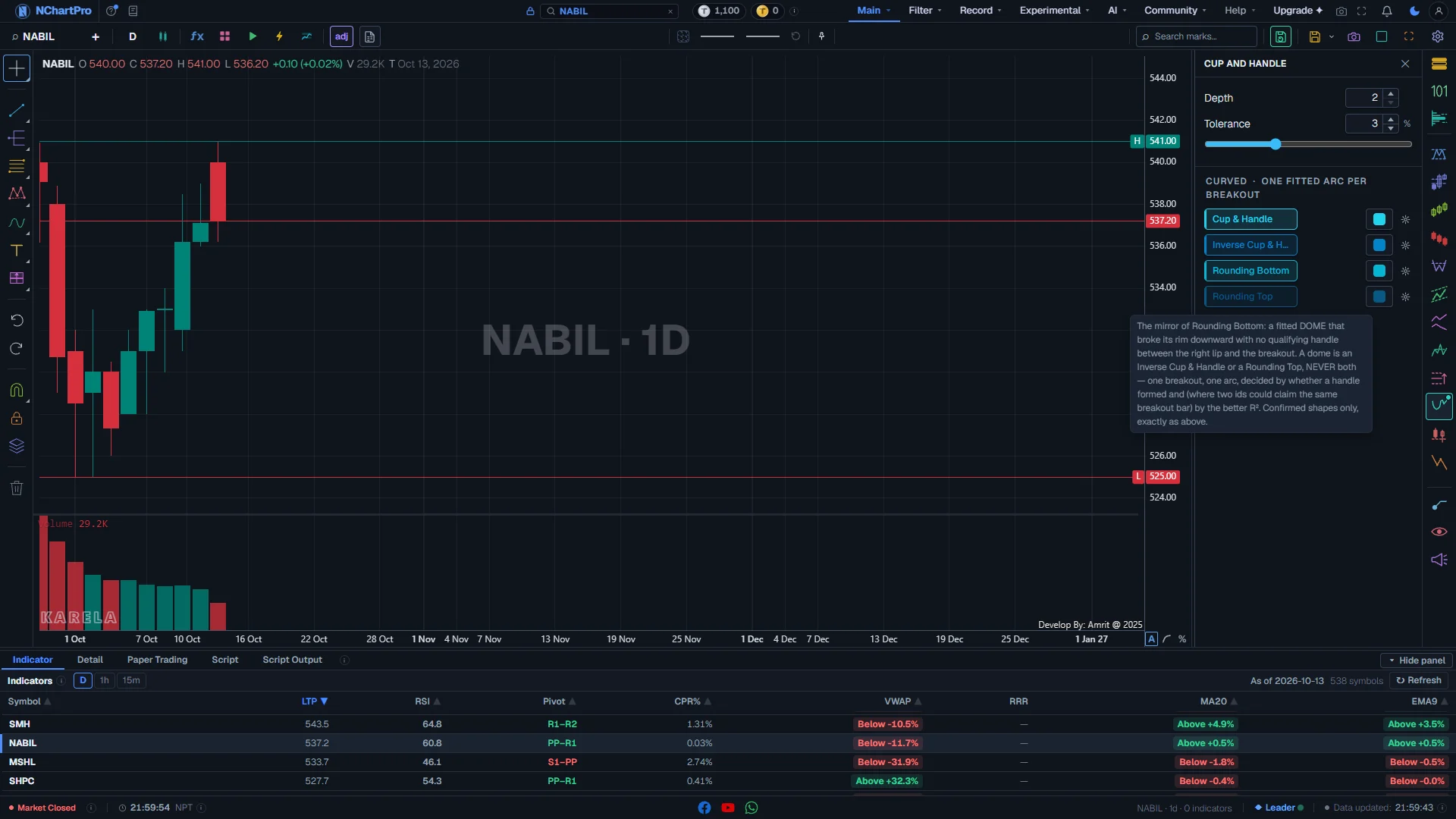
Cup and Handle (CH) open on a daily chart, with all four rows switched on. Each part with a close-up of the real screen; the numbers match the dots on the picture.
Cup and Handle panel
Opens from the CH chip in the right-hand mark column. Two number boxes and four rows.
How — Click CH to open it; click it again, the ✕, or press Escape to close. Shapes you switched on stay on the chart.
Depth
Which swing highs and lows can be the rims (the two lips) of a cup. 2 to 20, starts at 2.
How — Type a number or use the arrows. Higher numbers use only bigger swings, so you get fewer, larger shapes.
- The grey "pivots" badge counts how many turning points this depth finds on the loaded candles.
- A higher depth also makes each breakout appear a little later, because the right lip must first be confirmed as a turning point.
- This box is shared with other mark panels that use Depth.
Tolerance
How unequal the two lips may be, in % of the lip price. 0.5 to 8 %, starts at 3 %.
How — Drag the slider or type a number. Raise it to allow lips further apart; lower it for cleaner cups only.
- It also sets how deep the bowl must be: 10 % of the lip price at 3 %, 5 % at 6 %. So a higher number allows shallower bowls too.
- It does NOT change how well the curve must fit. That test is fixed.
- This box is shared with other mark panels that use Tolerance.
The four shapes
One search, four possible answers. Each breakout gets at most one of them.
How — Switch on all four to see every rounded shape the search found, split by type.
- Cup & Handle: a rounded base, a small dip (the handle), then a close up through the lip level.
- Inverse Cup & Handle: a rounded top, a small bounce, then a close down through the lip level. In NEPSE that is a reason to exit or stay out.
- Rounding Bottom: the same rounded base and breakout, but no proper handle formed.
- Rounding Top: the same rounded top and break down, with no proper handle.
One row
Each row is one shape in its own colour. The colour box and the gear set how it is drawn.
How — Click the name to switch it on or off. The colour box changes colour, shade and line. The gear (⚙) opens the shape's own inputs (for example how long a handle may be) and its style in one box.
- All four use cool colours that do not mean up or down: bright cyan for Cup & Handle, cyan for Rounding Bottom, deep blue for Inverse Cup & Handle, dark blue for Rounding Top.
- On: the button fills with its colour. Off: grey with a thin coloured line at its left edge.
What is drawn on the chart
A shaded curved bowl over the candles, a flat line across the top of the cup with the shape's name, and small triangles at the key points.
How — Zoom out on a daily chart — these shapes take months. If the curve does not look like a bowl to you, do not trust it.
- Shaded arc: the curve that was fitted to the closing prices.
- Flat line with the name ("Cup & Handle", "Inv Cup & Handle", "Rounding Bottom", "Rounding Top"): the lip level that price had to close through.
- Triangles: the left lip, the right lip, the lowest (or highest) point of the bowl, the handle (if any), and the breakout candle.
- Only finished shapes are drawn. A bowl still forming, with no breakout yet, is never shown.
- No price target is drawn.
Reading the numbers
- Cup: a rounded base between two lips at about the same price.
- Lip (rim): the two swing points the cup starts and ends at; the flat line joins them.
- Handle: the small dip after the right lip, before the breakout.
- Breakout: the candle that closes through the lip level. It is what puts the shape on the chart.
- Rounding Bottom (also called a saucer): a cup with no proper handle.
What it does not do
- These shapes are rare by design. An empty chart usually means there is no clean rounded shape, not that something is broken.
- Volume is not part of the test.
- Only loaded candles are searched. Scroll left to load more history.
- A finished cup is not a promise. Many breakouts fail. The shape is a reading of the past, not advice.
- Depth and Tolerance are shared with other mark panels, so changing them here changes those panels too.
Questions people ask
The handle. Both are the same rounded base. A cup has a small dip after the right lip before the breakout; a rounding bottom does not. One breakout is never both.
Most often there is simply no clean rounded shape in the loaded candles. Load more history, use the daily chart, or raise Tolerance a little.
No. The fit rule (75 %), the beat-a-V test and the low-in-the-middle test are fixed, so the panel never draws a sharp V as a cup.