

EMI
The instalment is the number the bank quotes you. The total interest is the number that decides whether the loan was a good idea.
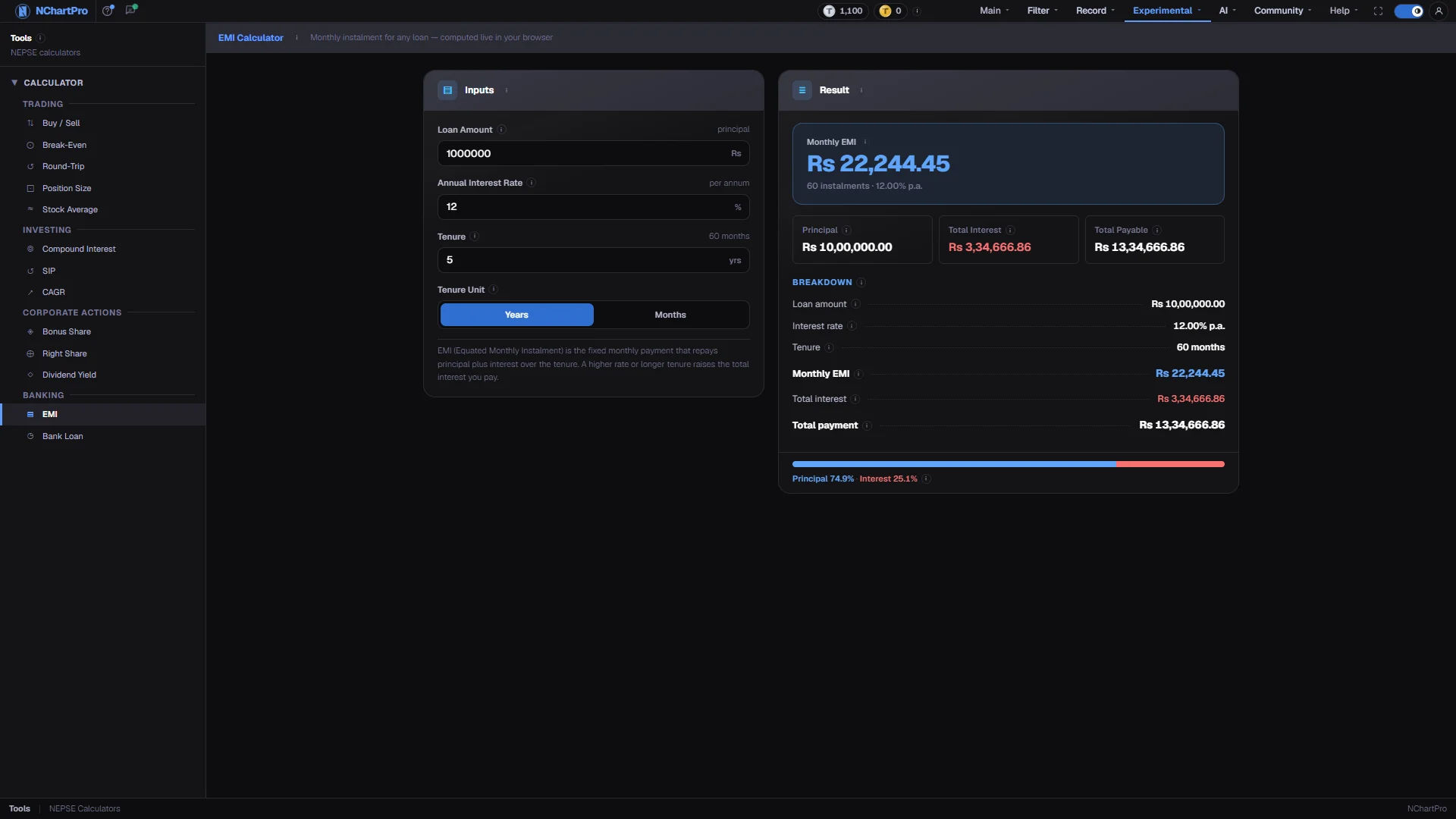
What this page is
Three inputs — the amount borrowed, the annual rate and the tenure — produce the equated monthly instalment: the fixed sum you pay every month until the loan clears.
Underneath, the same figures are restated as total payable and total interest, with a bar showing how your repayment splits between the loan itself and the bank's charge. A longer tenure makes the monthly figure comfortable and the red slice larger.
Why it helps you
- Relevant only if you are considering margin or a loan against shares. Put the loan rate beside the return you honestly expect from trading, not the return you hope for.
- A borrowed position magnifies both directions. The EMI keeps arriving whether or not the trade worked.
- The comparison worth making is the loan rate against your realistic long-term return. Borrowing at 12% to invest for an assumed 12% leaves you with the risk and none of the reward.
- Also useful for the ordinary reason — a home or vehicle loan — where knowing the total interest before signing is the whole point.
When to use it, and where to find it
- Before agreeing to any loan, including one taken against your portfolio.
- When a bank offers a longer tenure to lower the instalment, so you can see what that convenience costs.
Try it — a short walkthrough
- 1Enter the amount and the rateThe rate is annual. The calculator converts it internally to a monthly figure and assumes it never changes.See this part in detail →
- 2Set the tenure and its unitSwitch between Years and Months with the control beneath. Changing the unit re-clamps the value, so 200 months cannot silently become 200 years.See this part in detail →
- 3Read the split barThe bar at the bottom shows what share of everything you repay is principal and what share is interest. Extend the tenure and watch the red grow.See this part in detail →
Every part of the page
In the order you meet them on screen, each with a close-up of the real thing. The numbers match the dots on the figure above.
Loan Amount
The sum you borrow — the "principal". Interest is charged on the part of it you still owe, so it shrinks as you repay.
How — Enter the amount the bank actually disburses, not the value of what you are buying.
- This is the P in the EMI formula.
Annual Interest Rate
The yearly interest rate the bank charges. It is converted internally to a monthly rate.
How — On a floating-rate loan this can change later; the calculator assumes it stays fixed for the whole tenure.
- Monthly rate i = annual rate ÷ 12 ÷ 100.
Tenure
How long you take to repay. The switch below lets you enter it in years or in months; the hint shows the resulting number of months either way.
How — Stretch the tenure and watch the EMI fall while Total Interest climbs — that is the trade-off in one move.
- Years are multiplied by 12 to get n, the number of instalments and the exponent in the formula.
Monthly EMI
The fixed amount leaving your account every month until the loan is cleared, with the number of instalments and the rate restated underneath.
How — Check it against your monthly income before committing — this is the number you live with.
- EMI = P × i × (1+i)^n ÷ ((1+i)^n − 1).
- The payment stays the same every month, but early instalments are mostly interest and later ones mostly principal.
Principal, interest, total payable
Principal is what you borrowed. Total Interest is the extra you pay the bank over the whole loan. Total Payable is everything you will have paid by the last instalment.
How — Compare Total Interest with the Principal — on a long loan the interest can rival the loan itself.
- Total payable = EMI × number of months.
- Total interest = total payable − loan amount.
Principal vs Interest bar
Of every rupee you repay, how much goes back on the loan itself (blue) and how much is the bank's interest (red).
How — Raise the rate or lengthen the tenure and watch the red slice grow.
- Principal share = loan amount ÷ total payable × 100 · Interest share = total interest ÷ total payable × 100.
Reading the numbers
- EMI = P × i × (1 + i)^n ÷ ((1 + i)^n − 1), where P is the loan amount, i is the annual rate ÷ 12 ÷ 100, and n is the tenure in months.
- When the rate is zero this falls back to EMI = P ÷ n.
- Total payable = EMI × n. Total interest = total payable − P.
- Principal share = P ÷ total payable × 100. Interest share = total interest ÷ total payable × 100.
- The loan amount is capped at Rs 1 crore, the rate at 25% a year — deliberately above the ordinary Nepali lending range — and the tenure at 20 years or 240 months.
What it does not do
- It assumes a fixed rate for the whole tenure. Most Nepali lending is floating, so the real instalment will move when the base rate does.
- Loan processing fees, insurance, service charges and prepayment penalties are all excluded. The real cost of borrowing is higher than the total interest shown.
- Prepayment is not modelled. Paying extra early changes the schedule substantially and none of that appears here.
- For a year-by-year view of interest paid and balance remaining, use the Bank Loan calculator instead.