

Bank Loan
Bank Loan is EMI with the receipts attached: it shows, year by year, how little of an early instalment actually reduces what you owe.
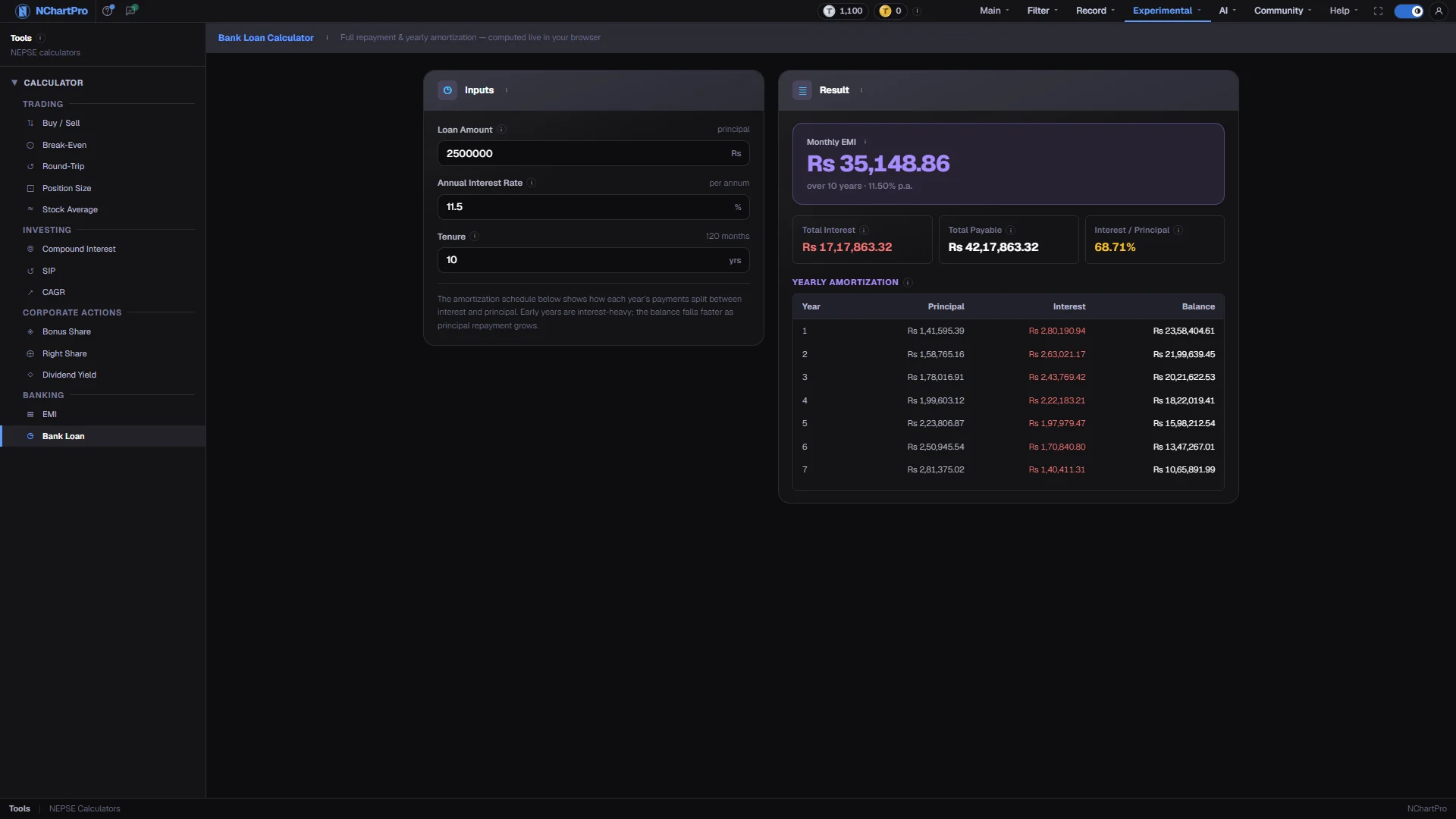
What this page is
It computes the monthly instalment exactly as the EMI calculator does, then walks the loan month by month and rolls the result up into a yearly table: how much went on principal, how much on interest, and what was still outstanding at the end of each year.
The table is the reason to use this page. Early on, most of each payment is interest and the balance barely moves. Later the split reverses and the balance falls quickly.
Why it helps you
- Only relevant if you are borrowing to trade. The schedule shows how long the loan stays close to its full size, which is how long you would be carrying it in a bad stretch.
- A trading loss and an interest-heavy early schedule compound each other. The table makes that visible in a way a single EMI figure does not.
- This is the page for a real loan — a home, a vehicle, a business. Reading the interest column of the first three years is the honest cost of borrowing.
- It is also the right place to test whether a shorter tenure is affordable. The instalment rises, but the total interest column falls sharply.
When to use it, and where to find it
- Before signing a loan agreement, once you have the offered rate and tenure.
- When comparing two offers with different tenures, where the lower instalment is often the more expensive loan.
Try it — a short walkthrough
- 1Enter the loan and the rateThe rate steps in quarter points, which matches how Nepali banks usually quote. The schedule assumes it never changes.See this part in detail →
- 2Try two tenuresSet the tenure you were offered, note the total interest, then shorten it by a few years and compare. The instalment rises far less than the interest falls.See this part in detail →
- 3Read the first three rows of the scheduleScroll the yearly amortization table and compare the Principal and Interest columns in the early years against the last ones.See this part in detail →
Every part of the page
In the order you meet them on screen, each with a close-up of the real thing. The numbers match the dots on the figure above.
Loan Amount
The sum you borrow — the principal. Interest is charged only on the part still outstanding, which is why the schedule below changes shape over time.
How — Enter the amount the bank disburses to you.
- This is the P in the EMI formula.
Annual Interest Rate
The yearly rate the bank charges, converted internally to a monthly rate.
How — Nudge it up by one percent and see how much the Total Interest grows — small rate differences compound over a long tenure.
- Monthly rate i = annual rate ÷ 12 ÷ 100.
- The schedule assumes the rate NEVER changes, so a floating-rate loan will differ in practice.
Tenure in years
How many years you take to repay. The hint shows the resulting number of monthly instalments.
How — A longer tenure means a smaller EMI but far more total interest — check both before choosing.
- Number of instalments n = years × 12.
Monthly EMI
The fixed amount you pay the bank every month until the loan is cleared.
How — The payment never changes, but the interest/principal split inside it does — the schedule below shows exactly how.
- EMI = P × i × (1+i)^n ÷ ((1+i)^n − 1).
What the loan really costs
Total Interest is the cost of borrowing over the whole tenure. Total Payable is everything you will have paid by the final instalment. Interest / Principal expresses the interest as a share of what you borrowed.
How — Use the Interest / Principal figure to compare two loans with different tenures fairly.
- Total payable = EMI × months · Total interest = total payable − loan amount.
- Interest / Principal = total interest ÷ loan amount × 100. 60% means Rs 60 of interest for every Rs 100 borrowed.
Yearly amortization
"Amortization" is simply the schedule of how the loan gets paid off. One row per year: how much reduced the loan, how much was the bank's charge, and what you still owe at the end of that year.
How — Scroll it and compare year 1 with the last year — the same EMI does very different work at each end.
- Each month: interest = outstanding balance × monthly rate; principal = EMI − interest; the balance drops by the principal part.
- The last row clears the remainder, so the closing balance ends at 0.
Reading the numbers
- EMI = P × i × (1 + i)^n ÷ ((1 + i)^n − 1), where P is the loan amount, i is the annual rate ÷ 12 ÷ 100, and n is years × 12 months.
- The schedule is built one month at a time: interest part = outstanding balance × i; principal part = EMI − interest part; the balance falls by the principal part. A final instalment is trimmed so the loan is never overpaid.
- Rows are emitted every 12 months and at the final month, so a part-year tenure produces a shorter last row.
- Total payable = EMI × n. Total interest = total payable − P. Interest / Principal % = total interest ÷ P × 100, which reads as rupees of interest per Rs 100 borrowed.
- The loan amount is capped at Rs 1 crore, the rate at 25% a year and the tenure at 20 years.
What it does not do
- It assumes a fixed rate for the whole term. Nepali lending is largely floating, so a real schedule is rebuilt every time the base rate moves.
- Processing fees, insurance, service charges and prepayment penalties are excluded.
- Prepayment is not modelled at all. Paying a lump sum early reshapes the schedule and cuts total interest substantially, and none of that is shown.
- The schedule is grouped by year, not by month. There is no month-level table on this page.