

Dividend Yield
A 15% dividend does not mean 15% of the share price. In NEPSE it means Rs 15 a share, and what that is worth depends entirely on what you paid.
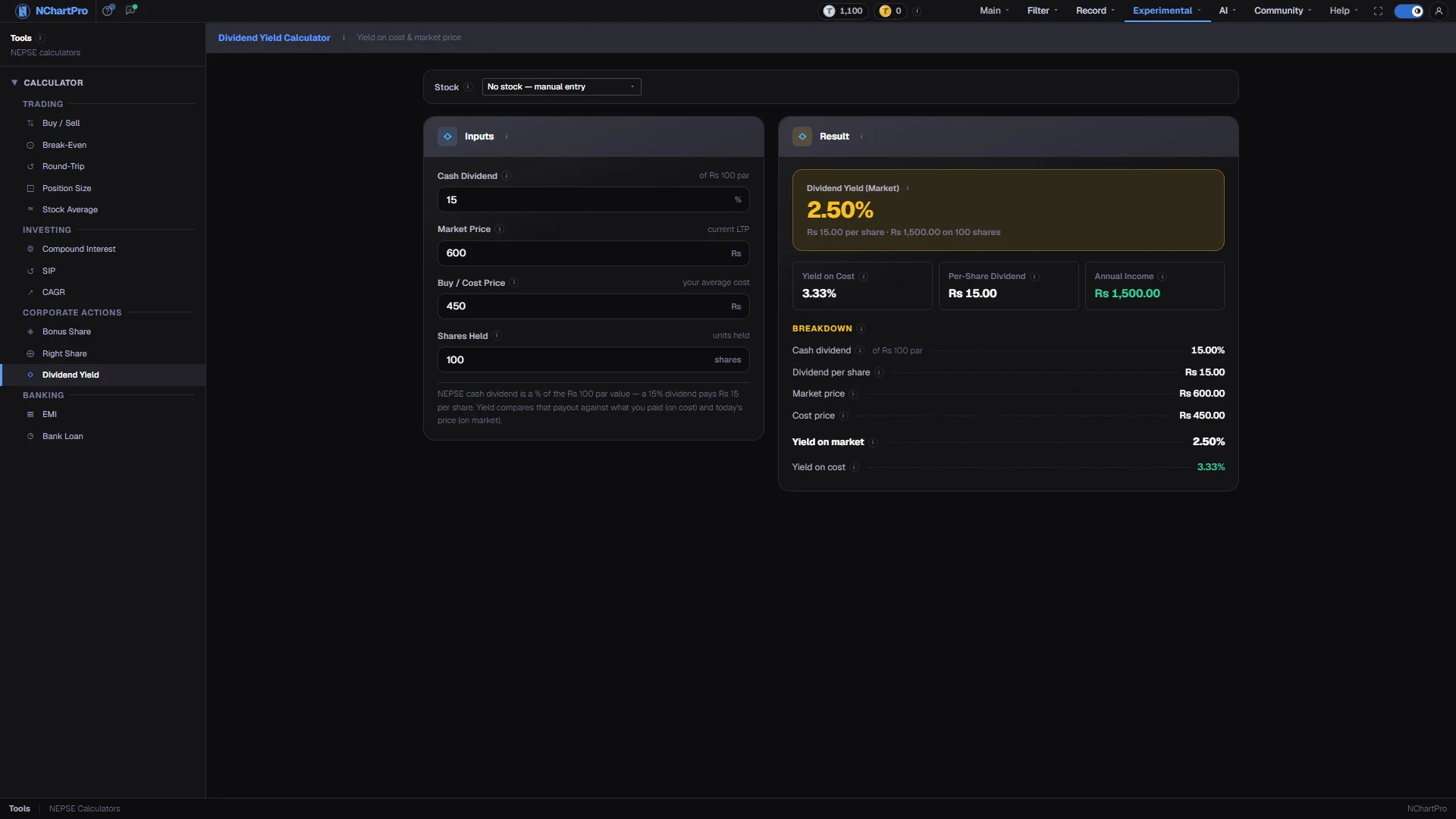
What this page is
This converts a declared cash dividend into rupees per share, then measures it two ways: against today's market price, which is what a new buyer would earn, and against your own cost price, which is what you earn.
The distinction matters more than it looks. A share bought at Rs 300 that now trades at Rs 900 pays the same rupees either way, but the yield on cost is three times the yield on market.
Why it helps you
- Of little use for a short-horizon trade, beyond knowing that the price adjusts down on the ex-dividend date and that the drop is expected rather than a sell-off.
- Worth one look before holding through a book closure, since the cash arrives weeks later while the price adjusts immediately.
- This is the investor's calculator on this page, and yield on cost is the number to watch. It is the compounding record of a good entry, and it keeps rising as the company raises its payout regardless of what the market price does.
- Compare yield on market against a fixed-deposit rate before buying for income. If a bank pays more with no price risk, the dividend case has to rest on growth rather than yield.
When to use it, and where to find it
- When a company announces its dividend and you want to know what it pays you.
- Once a year across your income holdings, to see which entries are actually earning their keep.
Try it — a short walkthrough
- 1Enter the declared cash dividendType only the cash percentage the company announced. If the announcement also includes a bonus component, that belongs in the Bonus Share calculator.See this part in detail →
- 2Add the market price and your costMarket price gives yield on market; your average buy price gives yield on cost. The two together are the whole point of the page.See this part in detail →
- 3Set your share count for the income figureShares Held only converts the per-share dividend into your total annual income. It does not affect either yield.See this part in detail →
Every part of the page
In the order you meet them on screen, each with a close-up of the real thing. The numbers match the dots on the figure above.
Cash Dividend %
The cash dividend the company announced, as a percentage of the Rs 100 par value — not of the market price.
How — Enter only the CASH part. If the company also declared bonus shares, that part belongs in the Bonus Share calculator.
- Dividend per share = Rs 100 × this % ÷ 100. So 15% pays Rs 15 per share.
Market Price
The share's last traded price today. It is the denominator of the headline "yield on market" figure.
How — Raise it and watch the yield fall even though the payout has not changed — that is the whole relationship in one move.
- Yield on market = dividend per share ÷ Market Price × 100.
Buy / Cost Price
What you actually paid per share, on average. It gives the "yield on cost" — the return YOU earn, as opposed to what a new buyer earns.
How — Use your real average cost; the Stock Average calculator works it out if you bought in several lots.
- If you bought cheap, your yield on cost stays high no matter what the market price does later.
Shares Held
How many shares (kitta) you own. Used only to turn the per-share dividend into your total yearly income.
How — It does not affect either yield percentage — only the rupee income figure.
- Annual income = Shares Held × dividend per share.
Dividend Yield (Market)
The cash return a buyer at today's price would earn from the dividend alone, ignoring any price movement.
How — Compare it with a fixed-deposit rate to judge whether the share is paying well for its price.
- Yield on market = dividend per share ÷ Market Price × 100.
- It is based on this ONE declared dividend — companies can change or skip it next year.
Yield on cost and your income
Yield on Cost is what YOU earn against the price you actually paid. Per-Share Dividend is the rupees each share pays. Annual Income is the total cash for your whole holding.
How — Watch the two yields diverge as you change the market price — the cost yield is yours and does not move with it.
- Yield on cost = dividend per share ÷ your Cost Price × 100.
- Annual Income is BEFORE the dividend tax the company deducts at source.
Reading the numbers
- Dividend per share = Rs 100 par value × cash dividend % ÷ 100. The Rs 100 par value is fixed in the app, because it is the NEPSE standard for ordinary shares. A 15% dividend therefore pays Rs 15 per share whatever the share trades at.
- Yield on market = dividend per share ÷ market price × 100.
- Yield on cost = dividend per share ÷ your buy/cost price × 100.
- Annual income = shares held × dividend per share.
- The cash dividend field is capped at 100% of par, i.e. Rs 100 per share. Share count is capped at 99,999 and prices at Rs 99,999 when no stock is selected.
What it does not do
- The figure is before tax. Nepal deducts dividend tax at source, so the cash that reaches you is less than Annual Income shows.
- It uses one declared dividend. Companies change or skip payouts, so this is not a forward yield and should not be read as a recurring income stream.
- Bonus shares are ignored here. A declaration of 10% cash plus 10% bonus needs both this calculator and the Bonus Share one.
- Par value is fixed at Rs 100 and cannot be changed on the page, so an instrument with a different par will be wrong.