

Bonus Share
A bonus issue gives you more shares and takes the price down to match. Your total value does not change on the day, which is why the fall alarms people who did not expect it.
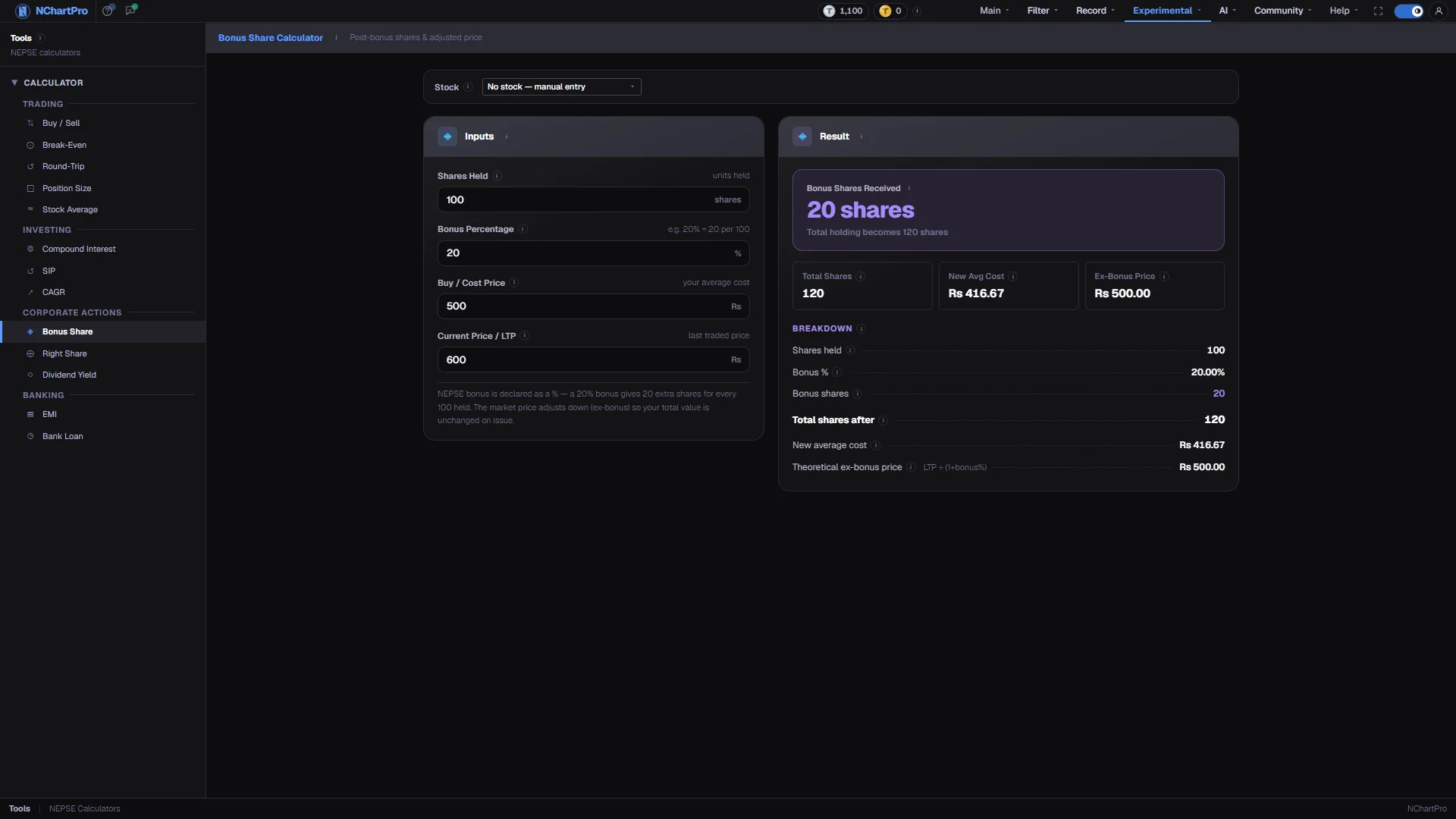
What this page is
Enter what you hold, the bonus percentage the company declared, your average cost and today's price. It returns the free shares you receive, your new lower average cost, and the price the share should theoretically open at once the market adjusts.
The point of the calculation is reassurance with arithmetic behind it. Your share count goes up, your per-share cost goes down, and the quoted price drops in exactly the same proportion.
Why it helps you
- Read the ex-bonus price before the book-closure date so a perfectly ordinary adjustment does not read as a crash on your chart the next morning.
- The bonus shares themselves arrive weeks after the ex-date, which means a gap where your holding shows fewer shares at the lower price. That is a settlement lag, not a loss.
- Your new average cost is the number that matters, because every future gain, tax calculation and yield-on-cost figure is measured from it.
- Bonus issues are how a long-term NEPSE holding quietly compounds its share count. Running this each time keeps your cost basis correct rather than drifting.
When to use it, and where to find it
- When a company declares a bonus and you want to know what you will receive.
- Just before or just after the ex-bonus date, when the price has moved and you are checking whether the move was the adjustment or something real.
Try it — a short walkthrough
- 1Enter your holding on the book-closure dateOnly shares held on that date qualify. Buying after book closure earns you nothing from this issue.See this part in detail →
- 2Type the declared bonus percentageIn NEPSE a bonus is a percentage of what you hold — 20% means 20 extra shares for every 100.See this part in detail →
- 3Read the theoretical ex-bonus priceThe bottom row shows where the quoted price should sit after the adjustment, so your total holding value is unchanged on the day.See this part in detail →
Every part of the page
In the order you meet them on screen, each with a close-up of the real thing. The numbers match the dots on the figure above.
Shares Held and your cost
Shares Held is what you own ON THE BOOK-CLOSURE DATE — only those qualify for the bonus. Buy / Cost Price is what you paid per share on average.
How — If you bought after the book-closure date you get no bonus, however low the price was.
- The cost price is used only to work out your new, lower average after the bonus.
Bonus Percentage
The bonus the company declared, as a percentage of the shares you hold.
How — Type 20 for a 20% bonus. It drives both the extra shares AND the price adjustment.
- Bonus shares = Shares Held × Bonus % ÷ 100, rounded DOWN to a whole share.
- Theoretical ex-bonus price = LTP ÷ (1 + Bonus % ÷ 100).
Current Price / LTP
The share price in the market today, BEFORE the bonus adjustment.
How — Enter the last traded price; it is used only for the ex-bonus price and the value figures.
Bonus Shares Received
The free extra shares the company will credit to your demat account, and what your total holding becomes.
How — Note the rounding: a fractional entitlement is cut down to the whole share below it.
- Bonus shares = Shares Held × Bonus % ÷ 100, rounded DOWN.
- They usually arrive some weeks after the book-closure date, not immediately.
New average cost
Total Shares is your holding after crediting. New Avg Cost is your cost per share afterwards — LOWER, because the same money you already spent is now spread over more shares.
How — Remember: you did not actually save money. Only the per-share figure changed.
- New average = (Shares Held × your cost price) ÷ total shares after bonus.
Theoretical ex-bonus price
Where the price should sit after the bonus adjustment, so your total holding value is unchanged on the day. The fall is EXPECTED, not a loss.
How — Do not panic when the quoted price drops on the ex-bonus day — check it against this figure first.
- Ex-bonus price = LTP ÷ (1 + Bonus % ÷ 100). A 20% bonus at Rs 600 adjusts to Rs 500.
- The real opening price can differ — this is only the arithmetic benchmark.
Reading the numbers
- Bonus shares = shares held × bonus % ÷ 100, rounded DOWN to a whole share.
- Total shares after = shares held + bonus shares.
- New average cost = (shares held × your cost price) ÷ total shares after. Your total money spent is unchanged — it is simply spread over more shares.
- Theoretical ex-bonus price = current price ÷ (1 + bonus % ÷ 100). A 20% bonus at Rs 600 adjusts to Rs 500.
- The bonus percentage is capped at 100%, which is a 1:1 issue and the largest NEPSE makes in practice. Share count is capped at 99,999 and prices at Rs 99,999 when no stock is selected.
What it does not do
- No charges or taxes appear anywhere on this page. Receiving a bonus costs nothing, but selling the resulting shares later will carry the usual commission, SEBON fee, DP charge and Capital Gains Tax.
- The ex-bonus price is arithmetic, not a prediction. The real opening price on the ex-date reflects sentiment as well, and often differs.
- Fractional entitlements are rounded down. A holding of 105 shares with a 20% bonus yields 21 shares, and the remainder is handled by the company, not shown here.
- A declaration of cash plus bonus needs two calculators — put the cash part into Dividend Yield.