

Right Share
A rights issue is the one corporate action that asks you for money. This works out how much, how many shares it buys, and what the price does either way.
What this page is
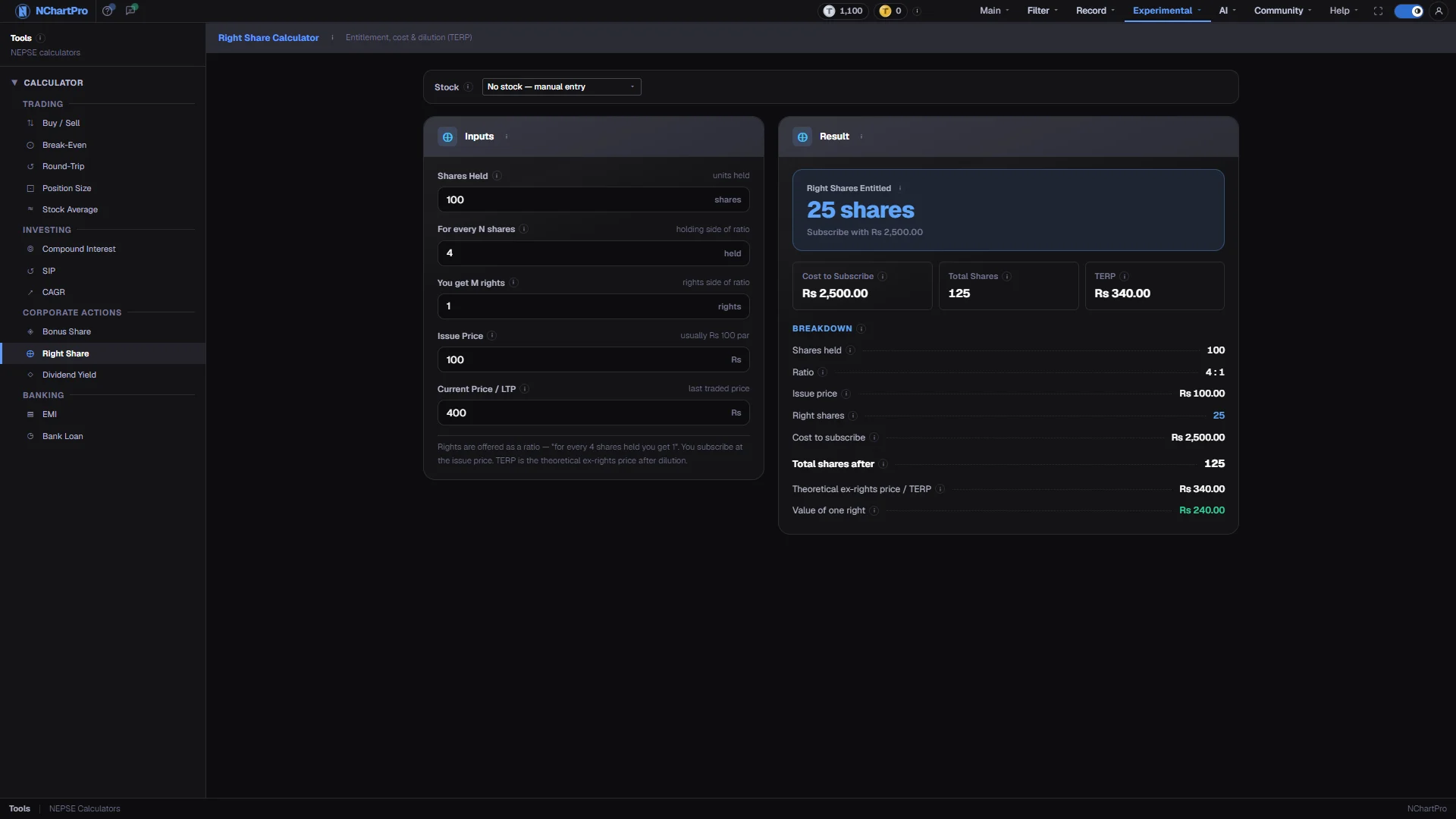
Enter your holding, the ratio the company announced, the issue price and today's market price. It returns how many new shares you may buy, the cash that takes, and TERP — the theoretical ex-rights price the stock should trade around once the cheap new shares are counted in.
The value-of-a-right line at the bottom is the built-in discount: how much cheaper the issue price is than the post-issue fair price. It is the reason a rights issue is worth taking up when the offer is genuinely below market.
Why it helps you
- TERP tells you the size of the mechanical price drop on the ex-rights date, which is easily mistaken for a sell-off on the chart.
- The subscription window and the actual crediting of shares are weeks apart, so money is committed long before the position is tradeable. Size accordingly.
- This is a dilution question first and a cash question second. If you do not subscribe, your stake shrinks and the price still adjusts down — you carry the dilution without the discount.
- Compare the cost to subscribe against what else that cash could do. A rights issue is the company asking for more capital, and the answer is not automatically yes.
When to use it, and where to find it
- As soon as a rights issue is announced, before the subscription window closes.
- On the ex-rights date, to confirm the price drop matches TERP rather than reflecting bad news.
Try it — a short walkthrough
- 1Enter the announced ratioFor a "4 : 1" issue, type 4 in the first box and 1 in the second. It reads as: for every 4 shares held you may buy 1 new share.See this part in detail →
- 2Set the issue priceIn NEPSE this is almost always the Rs 100 par value, which is why the field defaults to it. It sits far below the market price by design.See this part in detail →
- 3Read TERP and the value of one rightTERP is the blended price after dilution. The value of one right is TERP minus the issue price — if it is zero or negative, the offer carries no discount.See this part in detail →
Every part of the page
In the order you meet them on screen, each with a close-up of the real thing. The numbers match the dots on the figure above.
Shares Held and today's price
Shares Held is what you own on the BOOK-CLOSURE DATE — only those earn the entitlement. Current Price / LTP is the market price today, before the rights adjustment.
How — Both feed the diluted price (TERP) further down, so enter real numbers.
The announced ratio
Companies announce rights as "N : M". This box is the LEFT number (N) and the box under it is the right number (M).
How — For a "4 : 1" rights issue type 4 here and 1 below — read it as: for every 4 shares you hold, you may buy 1 new share.
- Right shares = (Shares Held ÷ N) × M, rounded DOWN to a whole share.
Issue Price
The price you pay for each new right share. In NEPSE this is almost always the Rs 100 par value, which is why the box starts at 100.
How — Leave it at 100 unless the offer document says otherwise.
- Cost to subscribe = right shares × this price.
Right Shares Entitled
How many new shares you are allowed to buy at the issue price, and the cash it takes to take up the full entitlement.
How — You still have to APPLY and pay within the offer window — the entitlement lapses if you do not.
- Right shares = (Shares Held ÷ N) × M, rounded DOWN.
- They are not free — see "Cost to Subscribe" just below.
Cost, total shares and TERP
Cost to Subscribe is the cash you must pay. Total Shares is your holding if you subscribe in full. TERP is the blended price the share should trade around afterwards.
How — Compare TERP with today's LTP: the drop between them is DILUTION, not a loss — provided you subscribed.
- TERP = (Shares Held × LTP + right shares × Issue Price) ÷ total shares after.
Value of one right
The built-in benefit of one right: how much cheaper the issue price is than the expected post-issue fair price.
How — Use it as the quick test of whether subscribing is worth the cash.
- Value of a right = TERP − Issue Price.
- If it is zero or negative the rights issue offers no discount, so subscribing has no built-in advantage.
Reading the numbers
- Right shares = (shares held ÷ N) × M for an "N : M" ratio, rounded DOWN to a whole share.
- Cost to subscribe = right shares × issue price.
- Total shares after = shares held + right shares.
- TERP = (shares held × current price + right shares × issue price) ÷ total shares after. It is a weighted average of your old shares at market and your new shares at the issue price.
- Value of one right = TERP − issue price.
- The issue price is deliberately NOT checked against the day's trading range, because a rights price fixed at Rs 100 par legitimately sits below the market low. Every other price field is checked when a stock is selected.
- Each side of the ratio is capped at 1,000, share count at 99,999 and prices at Rs 99,999.
What it does not do
- TERP is arithmetic. The real ex-rights price reflects how the market feels about a company asking for money, and rights issues often trade below TERP.
- No charges or taxes are applied. Subscribing carries application costs at your broker, and selling the resulting shares later carries the usual commission, SEBON fee, DP charge and Capital Gains Tax.
- Fractional entitlements are rounded down and are not shown separately.
- The calculator assumes you subscribe in full. Partial subscription or letting the entitlement lapse are not modelled — in both cases you take more dilution than TERP suggests.