

SIP
Investing a fixed sum every month is the least dramatic strategy there is, and over a decade the arithmetic is the argument for it.
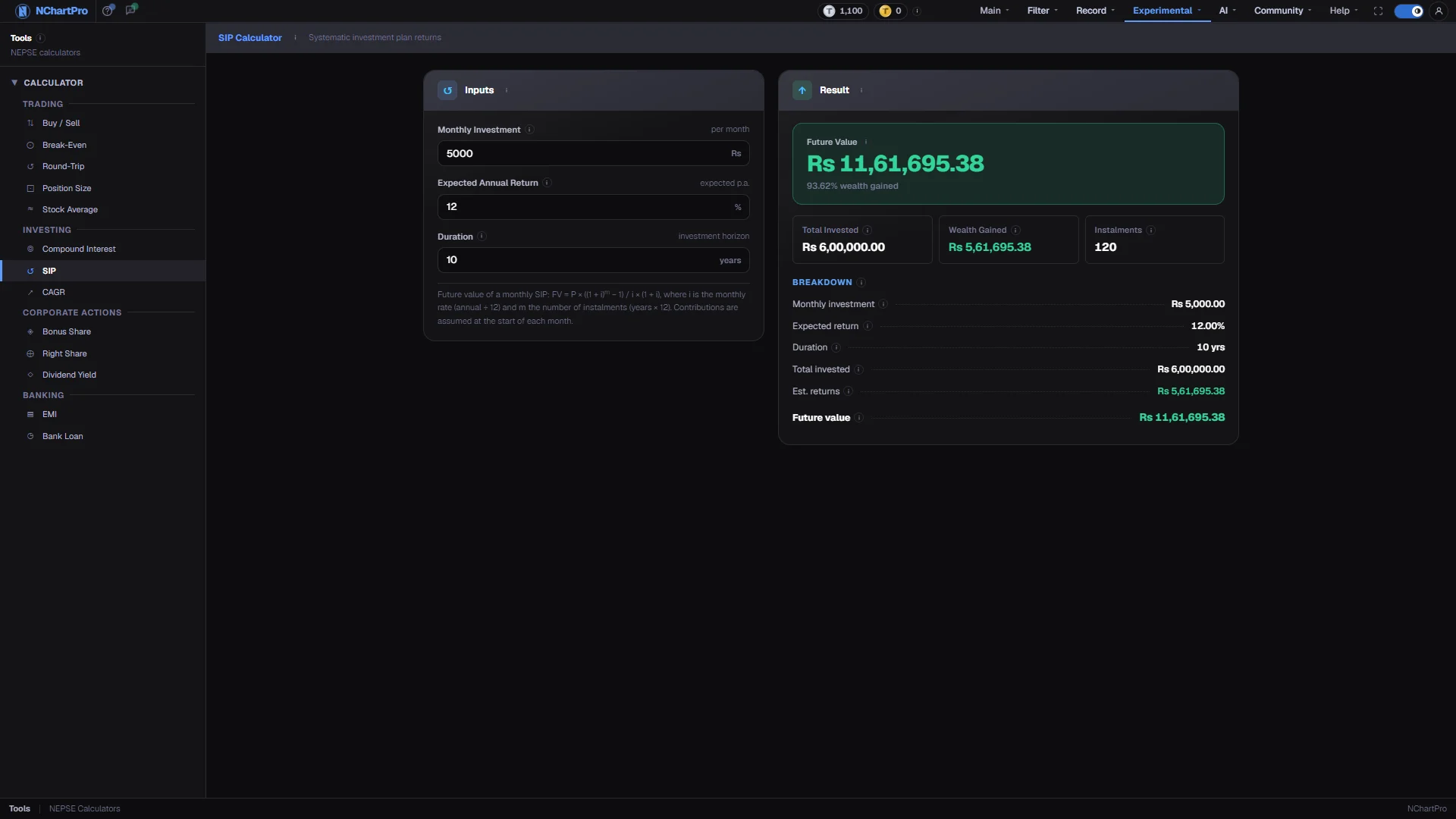
What this page is
A systematic investment plan means putting the same amount in every month instead of one lump sum. This projects what those instalments become, given a monthly amount, an assumed annual return and a duration.
The result splits into two parts that are worth reading separately: total invested, which is money out of your pocket, and wealth gained, which is the growth on top. Over long periods the second overtakes the first.
Why it helps you
- Nothing here applies to trading. There is no market, no price and no position — just a growth formula on numbers you supply.
- The one relevant reading is comparative: put your expected trading return in the rate field and see what the same money would do left alone.
- This is the investor's calculator on this page, and it is the one worth running annually. The gap between a 10-year plan and a 20-year one at the same instalment is the whole case for starting early.
- Try lowering the assumed return by a few points. A projection that only works at 18% a year is not a plan, and seeing it break is more useful than seeing it flourish.
When to use it, and where to find it
- When deciding what monthly amount to commit to.
- Once a year, to check whether the plan you set is still one you can sustain.
Try it — a short walkthrough
- 1Set the monthly amountThe figure you will actually pay in every month. Total invested is simply this multiplied by the number of instalments.See this part in detail →
- 2Choose an honest return rateThis is your assumption, not a forecast, and it is capped at 20% a year so projections stay in believable territory.See this part in detail →
- 3Compare invested against gainedThe chips under the result separate the money you paid in from the growth on top. Watching that ratio flip as you extend the years is the point of the page.See this part in detail →
Every part of the page
In the order you meet them on screen, each with a close-up of the real thing. The numbers match the dots on the figure above.
The three inputs
How much you invest each month, the yearly return you assume, and for how many years you keep going. That is all the formula needs.
How — Change any box and the result on the right updates as you type.
- Contributions are assumed at the START of each month, so each one earns for that month too.
Monthly Investment
The fixed amount you put in every single month. This is the P in the SIP formula.
How — Pick an amount you can genuinely keep up for the whole duration — a SIP only works if you do not stop.
- Total invested = this amount × years × 12.
Expected Annual Return
The yearly return you assume the investment will earn. Your own estimate — nothing here guarantees it.
How — Test a pessimistic rate as well as an optimistic one; the gap between them is the honest range.
- It is converted to a monthly rate: i = rate ÷ 12 ÷ 100.
Duration
How many years you keep paying the monthly instalment. The number of instalments m = years × 12.
How — Add five years and watch the future value jump far more than the extra money you put in — that gap is compounding.
Future Value
The estimated total value of the plan at the end of the duration — your instalments plus the returns they earned.
How — Read the "wealth gained" % as growth on top of everything you paid in.
- FV = P × ((1 + i)^m − 1) ÷ i × (1 + i).
- An estimate based on a steady return you assumed; real markets do not move in a straight line.
Invested vs gained
Total Invested is the money out of your own pocket. Wealth Gained is the estimated growth on top. Instalments is how many payments you make in all.
How — Watch how, over long durations, Wealth Gained overtakes Total Invested — that is the whole point of starting early.
- Total invested = monthly amount × instalments · Wealth gained = future value − total invested.
- Instalments = years × 12.
Reading the numbers
- Future value FV = P × ((1 + i)^m − 1) ÷ i × (1 + i), where P is the monthly instalment, i is the annual rate ÷ 12 ÷ 100, and m is years × 12.
- The trailing × (1 + i) is there because instalments are assumed to go in at the START of each month, so each one earns for that month too.
- When the rate is zero the formula degenerates to FV = P × m.
- Total invested = P × m. Wealth gained = FV − total invested, and the percentage under the headline is wealth gained ÷ total invested × 100.
- The instalment is capped at Rs 1 crore, the return rate at 20% a year and the duration at 20 years. No charges, tax or inflation are applied.
What it does not do
- The return rate is a number you assume. Nothing in the app forecasts it, and a market does not deliver a steady monthly return — the real path is uneven even when the average holds.
- Brokerage, Capital Gains Tax and inflation are all excluded. Real purchasing power at the end is meaningfully lower than the figure shown.
- It assumes you never miss an instalment and never withdraw. Both assumptions fail in practice.
- Nothing is saved between visits.