

Public Choice
Guessing a direction is easy and almost worthless; committing to a number and then being marked against what actually happened is the part that teaches you something.
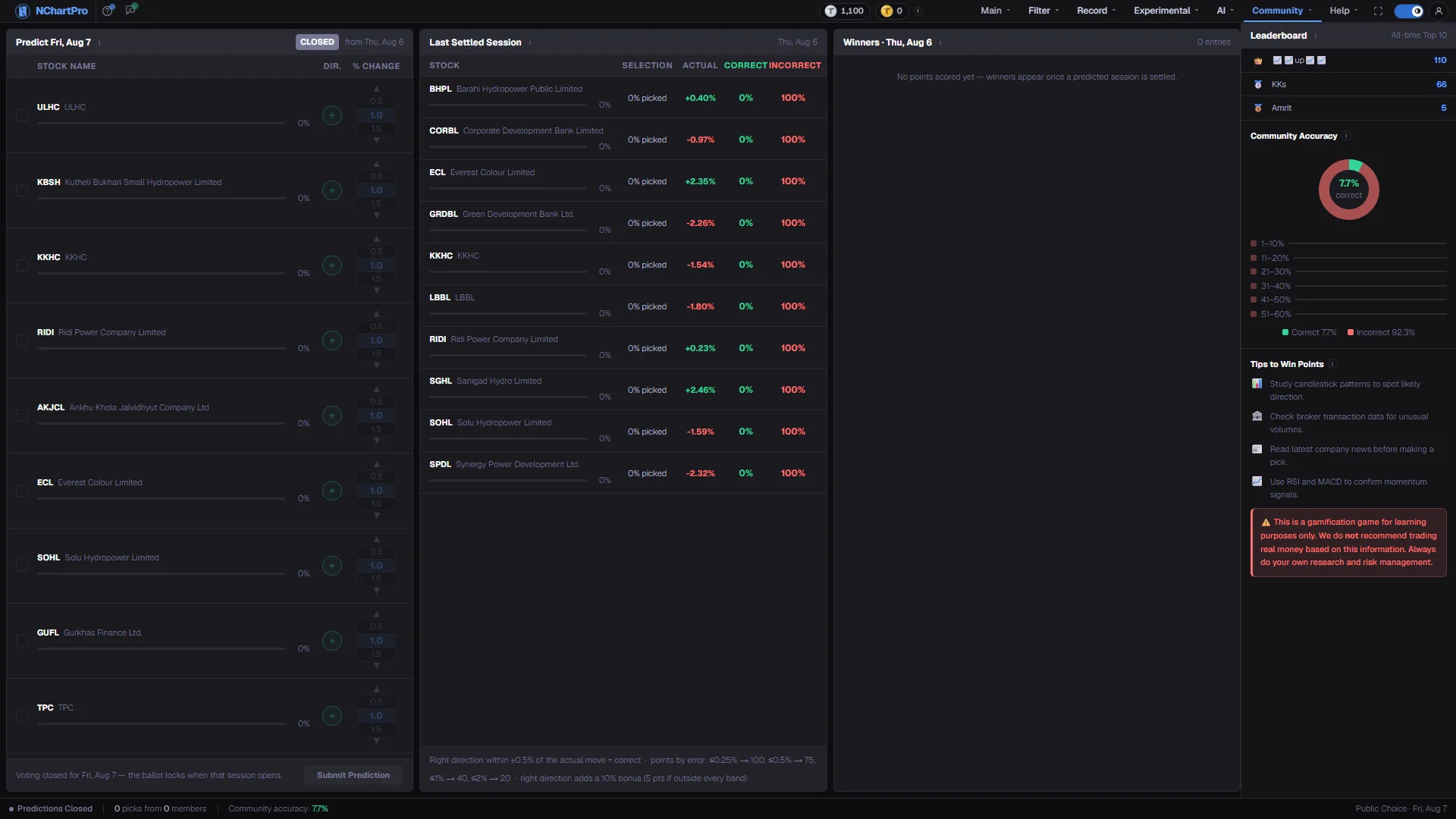
What this page is
Public Choice publishes ten stocks for the next trading day, chosen automatically by rule from the last session. You pick up to three of them, say for each whether it will rise or fall and by how much, and submit once. When that session settles against real closing prices, your picks are scored.
The scoring is deliberately harsh on vagueness. Points come from how close your percentage was, not from getting the direction right, and the direction alone is worth a small consolation. A careful estimate of the size beats a confident guess at the arrow.
The rest of the page is the record: how the previous ballot turned out, who scored best on it, the all-time leaderboard, and how accurate the whole community was. Those figures are about everyone, not about you.
Why it helps you
- This is the cheapest honesty test available to you. You already form a view on tomorrow every day; here it is written down before the fact and marked afterwards, which is exactly what your own trading never does.
- Note where you are wrong, not that you are wrong. Most people find they get direction right and size badly, which is a stop-loss and position-sizing problem rather than an analysis problem.
- The community accuracy figure is worth a glance for a different reason: when the crowd is badly wrong in one direction on a day, that is a sentiment reading you can carry into the real session.
- A one-day price move is noise on your horizon, so nothing here should touch a holding decision. Play it, if you play it, as practice in disciplined estimation and nothing more.
- The one genuinely transferable habit is committing to a range instead of a story. If you cannot put a number on how far a company should move on news, you do not yet have a view — only an opinion.
- The leaderboard rewards frequency as much as skill, since points only accumulate on days you submit. Do not read a high total as evidence that someone knows more than you do.
When to use it, and where to find it
- After the close, once the engine has published the ballot for the next trading day.
- Before the market opens, if you want to submit on the strength of an overnight view rather than yesterday's.
- The day after you submitted, to read the settled result while you can still remember what you were thinking.
Try it — a short walkthrough
- 1Do the homework before you look at the ballotTen names is a lot to work through, so open the chart for the ones you recognise first. The rule that put each stock on the list is hidden on purpose, so the ballot itself tells you nothing.See this part in detail →
- 2Choose three, and set a number you would defendTick at most three stocks, set the direction, then set the size. Anything between 0.0 and 15.0 in half-point steps is accepted, and the server checks the same range.See this part in detail →
- 3Submit once and leave itThe counter shows how many of your three picks are set. After submitting, the ballot becomes read-only and shows what was stored — that lock lives on the server, not in this tab.See this part in detail →
- 4Come back and read the settled sessionThe results panel shows each stock's real percentage change alongside what share of members picked it and how many were right. That comparison is the whole lesson.See this part in detail →
- 5Check your score against the bandsRead the scoring note next to the result. Seeing which band you fell into tells you whether your estimate was slightly off or in the wrong world entirely.See this part in detail →
Every part of the page
In the order you meet them on screen, each with a close-up of the real thing. The numbers match the dots on the figure above.
The ballot
The ten stocks for the next trading day. They are chosen automatically, by rule, from the last session — one slot per rule, no two the same.
How — Tick up to 3 stocks · the +/− circle toggles the direction · drag the drum or use its ▲ ▼ arrows to set the size of the move.
- Which rule put a stock on the ballot is deliberately hidden, so the pick stays your own call.
- Only ordinary shares are eligible — no indices, mutual funds, debentures or promoter shares.
- The % you set runs from 0.0 to 15.0 in 0.5 steps. The server checks the same range, so nothing outside it can be stored.
- The bar under each scrip is the share of all voters who picked that stock.
Submit and lock in
The counter tells you how many of your 3 picks are set; the button sends them.
How — Press Submit Prediction once you are happy. It then reads "Submitted ✓" and the ballot becomes read-only, showing your stored picks.
- One submission per trading day. Sending a second one for the same day is refused and the reason appears in this bar.
- The lock lives on the server, not in this tab: reload, or sign in on another device, and your picks are still there.
- ACTIVE in the card title means voting is still open; CLOSED means either nothing has been published yet, or voting has shut because the session being predicted has opened.
The last settled session
How the previous ballot actually turned out, scored once that session's closing prices existed.
- Selection — the share of voters who picked that stock.
- Actual — the stock's real % change for the settled session.
- Correct / Incorrect — the share of picks on that stock that were right.
- "not settled yet" in the corner means the last ballot has not been scored against real prices yet.
How points are given
Points reward how close your % was, not just the direction.
- A pick counts as CORRECT when the direction is right AND your % is within 0.5 of the actual move.
- Points by how far off you were: within 0.25% → 100, within 0.5% → 75, within 1% → 40, within 2% → 20.
- Getting the direction right adds a 10% bonus on top — or 5 points as a consolation if you missed every band.
- So a careful estimate of the SIZE beats a bold guess at the direction.
Winners of that session
The members who scored the most points on the last settled session, highest first. It is a single-day scoreboard, not the all-time one.
- A row appears only once that session has been settled against real closing prices.
- "+N pts" is what that member earned on that day alone. ① ② ③ mark the top three.
All-time leaderboard
The ten members with the highest total points ever earned in Public Choice — every settled session added up, not just the latest one.
- Points come only from settled predictions; an unsettled ballot adds nothing yet.
- These are game points for this leaderboard only — they are separate from TPoints.
Community accuracy
The share of ALL member picks in the last settled session that were correct — right direction and within 0.5% of the actual move. Green is correct, red is not.
- It measures the whole community, not you personally.
- The 10% bands underneath simply show which accuracy band the current figure has reached.
Tips and the warning
General guidance for making a better guess — fixed advice, not a signal about any of the ten stocks on the ballot.
- Nothing here is a recommendation to buy or sell a specific scrip.
- The red box repeats the rule that matters: this is a game for learning, so do not risk real money on it.
Reading the numbers
- Selection is the share of all voters who picked a stock; Actual is that stock's real percentage change for the settled session. They are unrelated numbers sitting side by side on purpose.
- A pick counts as correct when the direction is right and the size is within half a percentage point of what happened. That is the same rule the community accuracy figure uses.
- Winners is a single-day board and the leaderboard is every settled session added together, so a name can top one and be absent from the other.
- Points here are game points for this leaderboard only. They are not TPoints and they buy nothing.
What it does not do
- One submission per trading day, and no changes afterwards. A second attempt for the same day is refused and the reason appears in the bar above the button.
- Voting closes when the session you are predicting opens, so a late submission with the move already on the tape is refused. CLOSED in the card title means either nothing has been published yet or that cut-off has passed — both are backend states, not something you did.
- Nothing is scored until real closing prices exist. Until then the last ballot reads "not settled yet" and no winners are listed.
- Only ordinary shares are eligible, so indices, mutual funds, debentures and promoter shares never appear on the ballot.
- The tips panel is fixed general advice. It is not a hint about any of the ten stocks on the ballot, and it changes for nobody.
- This is a game. Nothing on the page is a recommendation, and the page says so itself. Do not put real money behind a pick you made here.
Questions people ask
Because picking the whole ballot is not a prediction. Limiting you to three forces the choice to mean something, and it is what makes the scores comparable between members.
Points are driven by how close your percentage was. Being right about the arrow but out by several points falls outside every band, and the direction alone is worth only a small consolation score.
Yes. The submission is stored on the server against your account, so reloading or signing in elsewhere shows the same locked ballot.
Automatically, by rule, from the previous session — one slot per rule, no stock twice, and only ordinary shares. The rules themselves are not published and which one picked which stock is never shown, so nobody can play the selection instead of the market.